June 2, 2011

3.18 Refractive Index

Recall and use the relationship between refractive index, angle of incidence and angle of refraction...


Refractive index is The ratio of the velocity of light in a vacuum to its velocity in a specified medium or simply put: how much the light is bent/refracted when it enters a specific medium.


to calculate the refractive index we use the formula:


n is the refractive index (this is purely a number and has no units)
i is the angle of incidence (in degrees °)
r is the angle of refraction (in degrees, 
°)

May 17, 2011

3.17 Refraction of light, Experiments

Describe experiments to investigate the refraction of light, using rectangular blocks, semicircular blocks and triangular prisms.

This worksheet show's how light is refracted through different perspex/glass blocks


Notice that in the prism diagram Red is refracted the least and Violet the most

EXTRA: Here is an interesting video showing some cool stuff you can do with refraction.

3.16 Plane Mirrors

For an object reflected in a plane mirror, the image is...
  • The same size as the object
  • The same distance as the object from the mirror.
  • Virtual (not real)
  • Upright
  • Laterally Inverted

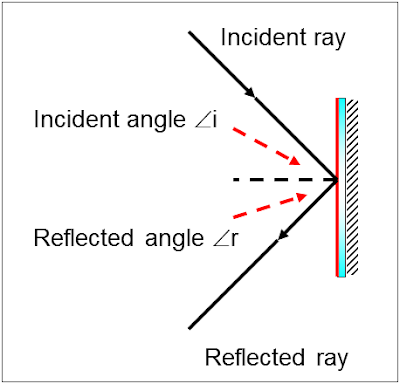
3.15 Angles of Incidence and Reflection

Recall that the angle of incidence equals the angle of reflection.

This image shows that both angles are equal.

This diagram shows the position of the angles and that they are measured from the normal.

3.14 Light waves

Light waves are transverse waves which can be reflected, refracted and diffracted

Reflection of light: The change in direction of a light wave so that it returns into medium from which it originated

Refraction of light: The bending of light,when it passes between materials of different density e.g from air to perspex:
 
Diffraction of light: Light Waves spreading into the shadow when they pass the edge or through a slit.

3.13 effects of excessive exposure to the human body

Recall the detrimental effects of excessive exposure of the human body to electromagnetic waves, including

Microwaves: Internal heating of body tissue
Infrared: skin burns
Ultraviolet: Damage to surface cells and blindness
Gamma rays:  cancer, mutation

3.12 Uses of Electromagnetic Radiation

Recall some of the uses of electromagnetic radiations

Radio waves
 - Broadcasting and communications
Microwaves
 - Cooking and satellite transmissions
Infrared
 - Heaters and night vision equipment
Visible light
 - Optical fibres and Photography
Ultraviolet
 - Fluorescent lamps
X-rays
 - observing the internal structures of objects and materials and medical applications
Gamma Rays
 - Sterilising food and medical equipment